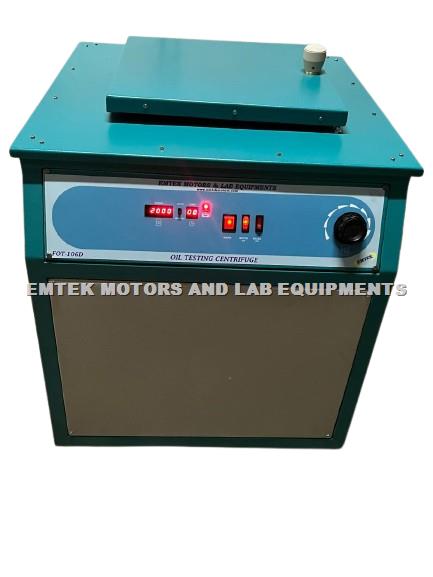
An oil testing centrifuge is a laboratory instrument used to determine the water and sediment (BS&W – Basic Sediment and Water) content in petroleum products, crude oil, fuel oils, lubricating oils, transformer oils, and related fluids. It separates components based on density by spinning samples at high speed.
Key features
- High-speed centrifugal separation
- Accurate measurement of water and sediment content
- Digital or analog speed control
- Temperature-controlled operation (on heated models)
- Robust, vibration-free construction
- Safety lid lock and imbalance protection
Typical specifications
- Maximum speed: 2,000–4,000 RPM (depending on the model)
- Maximum RCF: Up to 2,500 × g or higher
- Tube capacity: 4, 6, or 8 centrifuge tubes
- Tube volume: 100 mL (ASTM centrifuge tubes are common)
- Timer: 0–99 minutes or continuous operation
- Temperature range: Ambient to 80°C (for heated models)
- Power supply: 220–240 V AC, 50/60 Hz
Applications
- Petroleum testing laboratories
- Oil refineries
- Transformer oil testing
- Lubricating oil analysis
- Diesel and fuel quality testing
- Marine fuel inspection
- Power generation facilities
- Research and quality control laboratories
Common testing standards
Oil testing centrifuges are commonly used to perform tests according to standards such as:
- ASTM D4007
- ASTM D96
- ASTM D1796
- ISO 3735 (depending on laboratory requirements)
Advantages
- Fast and reliable separation
- High accuracy and repeatability
- Simple operation
- Suitable for routine quality control
- Durable construction for laboratory use
Selection considerations
When choosing an oil testing centrifuge, consider:
- Required testing standard (ASTM, ISO, or equivalent)
- Maximum speed and centrifugal force
- Number and size of tubes
- Heated or non-heated operation
- Digital or manual controls
- Safety features
- Calibration and certification requirements